
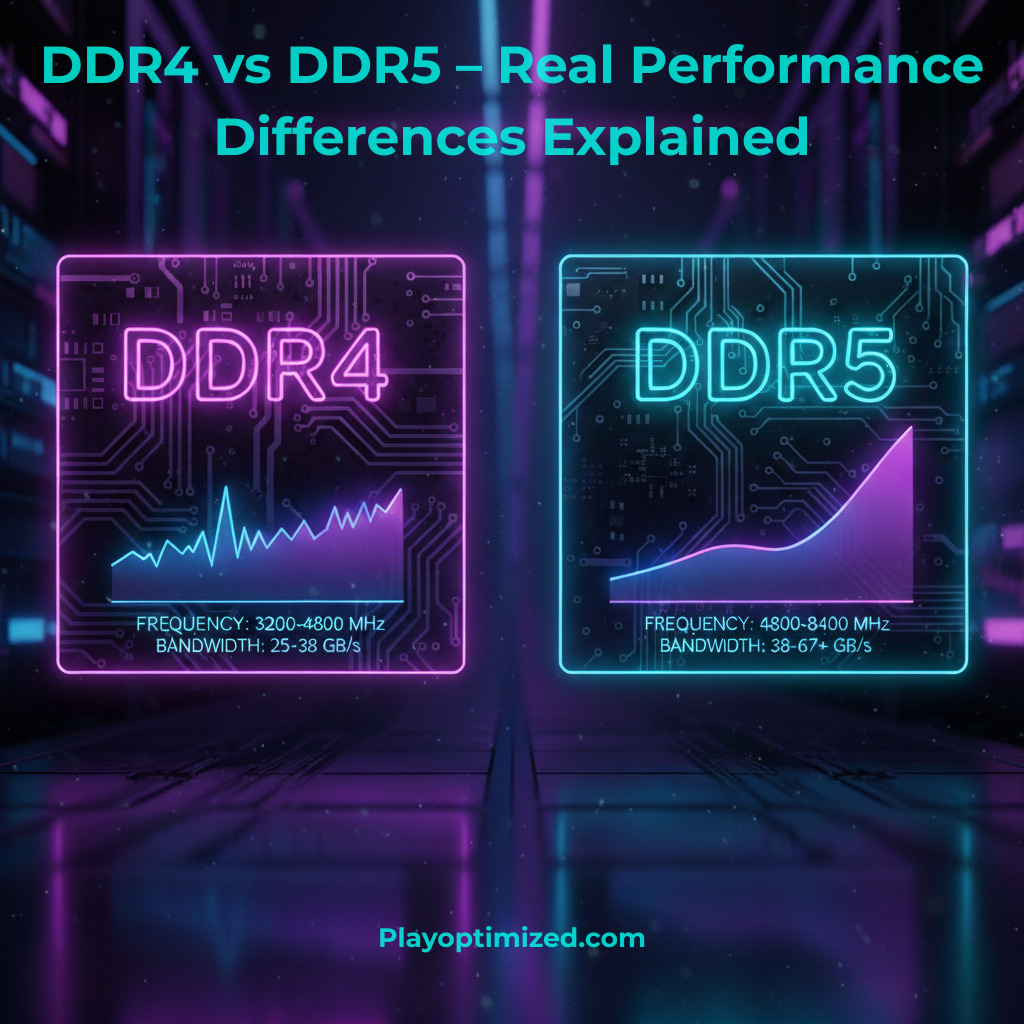
DDR4 vs DDR5 performance is one of the most debated topics when building or upgrading a PC today. While DDR5 promises higher speeds and better efficiency, DDR4 remains widely used and often cheaper. But how big is the real-world difference, and is DDR5 actually worth upgrading to?
In this guide, we break down the practical performance differences between DDR4 and DDR5, focusing on gaming, productivity, pricing, and future-proofing.
What Is DDR4 Memory?
DDR4 has been the standard PC memory for many years. It offers stable performance, wide compatibility, and excellent value.
Key DDR4 Characteristics
- Typical speeds: 2133–3600 MHz
- Lower latency compared to early DDR5 kits
- Mature platform with broad CPU and motherboard support
- Affordable and widely available
DDR4 still performs very well in most gaming and everyday workloads.
What Is DDR5 Memory?
DDR5 is the next-generation memory standard designed for higher bandwidth and improved efficiency.
Key DDR5 Characteristics
- Typical speeds: 4800–7200+ MHz
- Higher memory bandwidth
- Better power efficiency
- Improved memory management
DDR5 introduces new features that benefit modern CPUs and future software.
DDR4 vs DDR5 Performance in Gaming Benchmarks
Gaming FPS Differences
In most modern games:
- DDR5 offers 0–10% higher FPS compared to DDR4
- Differences are more noticeable in CPU-heavy games
- Higher resolutions reduce the performance gap
For GPU-limited gaming at 1440p or 4K, the difference is often minimal.
Competitive and High-Refresh Gaming
DDR5 can provide:
- Slightly higher minimum FPS
- Improved frame-time consistency
These gains matter most for competitive players using high-refresh-rate monitors.
Productivity and Workload Performance
Content Creation and Multitasking
DDR5 shows clearer benefits in:
- Video editing
- 3D rendering
- Large file compression
- Heavy multitasking
Higher bandwidth helps workloads that move large amounts of data.
Everyday Use
For browsing, office work, and light tasks, DDR4 and DDR5 feel almost identical.
Latency vs Bandwidth Explained
DDR5 has higher latency numbers, but:
- Its increased bandwidth often offsets latency
- Real-world performance depends on workload type
Latency-sensitive tasks may not benefit as much from DDR5 as bandwidth-heavy tasks do.
Platform Compatibility and Upgrade Considerations
DDR4 Compatibility
- Works with older Intel and AMD platforms
- Allows cheaper motherboard options
DDR5 Compatibility
- Required for newer CPU platforms
- Often paired with newer features like PCIe 5.0
You cannot mix DDR4 and DDR5 on the same motherboard.
Pricing and Value Comparison
DDR4 Value
- Lower cost
- Better price-to-performance for budget builds
DDR5 Value
- Higher cost but improving rapidly
- Better long-term investment for new builds
As DDR5 prices continue to drop, the value gap is shrinking.
Power Efficiency and Stability
DDR5 offers:
- Improved power efficiency
- Better power management per module
This can result in slightly lower power draw and improved system stability under load.
Who Should Choose DDR4?
DDR4 is the better choice if:
- You’re upgrading an existing system
- You’re building on a tight budget
- You mainly game at higher resolutions
Who Should Choose DDR5?
DDR5 makes sense if:
- You’re building a new PC
- You want future-proof hardware
- You do productivity-heavy work
Final Verdict on DDR4 vs DDR5 Performance
So, how big is the DDR4 vs DDR5 performance difference? For gaming, the gains are modest but real. For productivity and future platforms, DDR5 offers clear advantages. DDR4 remains an excellent value option, while DDR5 is the smarter long-term choice for new builds.
The best option depends on your budget, platform, and how you actually use your PC.